

The flexibility of a generalist workspace often functions as a liability for inventory control. Many teams utilize generalist tools for initial data organization. These systems offer high customization. These systems lack specialized architecture for high-volume operations. This technical comparison examines the Clikox vs Notion database regarding data structure and operational stability. Specialized systems prioritize functional precision. Specialized systems prevent data fragmentation. A structured architecture ensures reliable performance for growing teams.
Users frequently experience performance degradation when databases exceed 5,000 records. Slow search functionality and fragile links create operational friction in shared environments. A stable infrastructure is necessary for precise search and reliable team access. This article provides a technical analysis of search performance and data retrieval speeds. It describes how specialized systems maintain structural integrity during scaling. The analysis covers integrated management for inventory and content within a single administrative framework. It details specific benchmarks for system stability and data categorization. This comparison identifies the most efficient architecture for professional data management.
Key Takeaways
- Identify the operational differences between block-based generalist systems and specialized data structures for inventory control.
- Evaluate search indexing efficiency within the Clikox vs Notion database comparison to optimize data retrieval speeds.
- Examine the technical architecture of modular data types to prevent data fragmentation in high-volume environments.
- Review administrative control protocols including license activation and centralized dashboards for secure data access.
- Select a stable infrastructure for the integrated management of inventory and content assets.
Comparative Framework: Generalist Flexibility vs. Specialist Structure
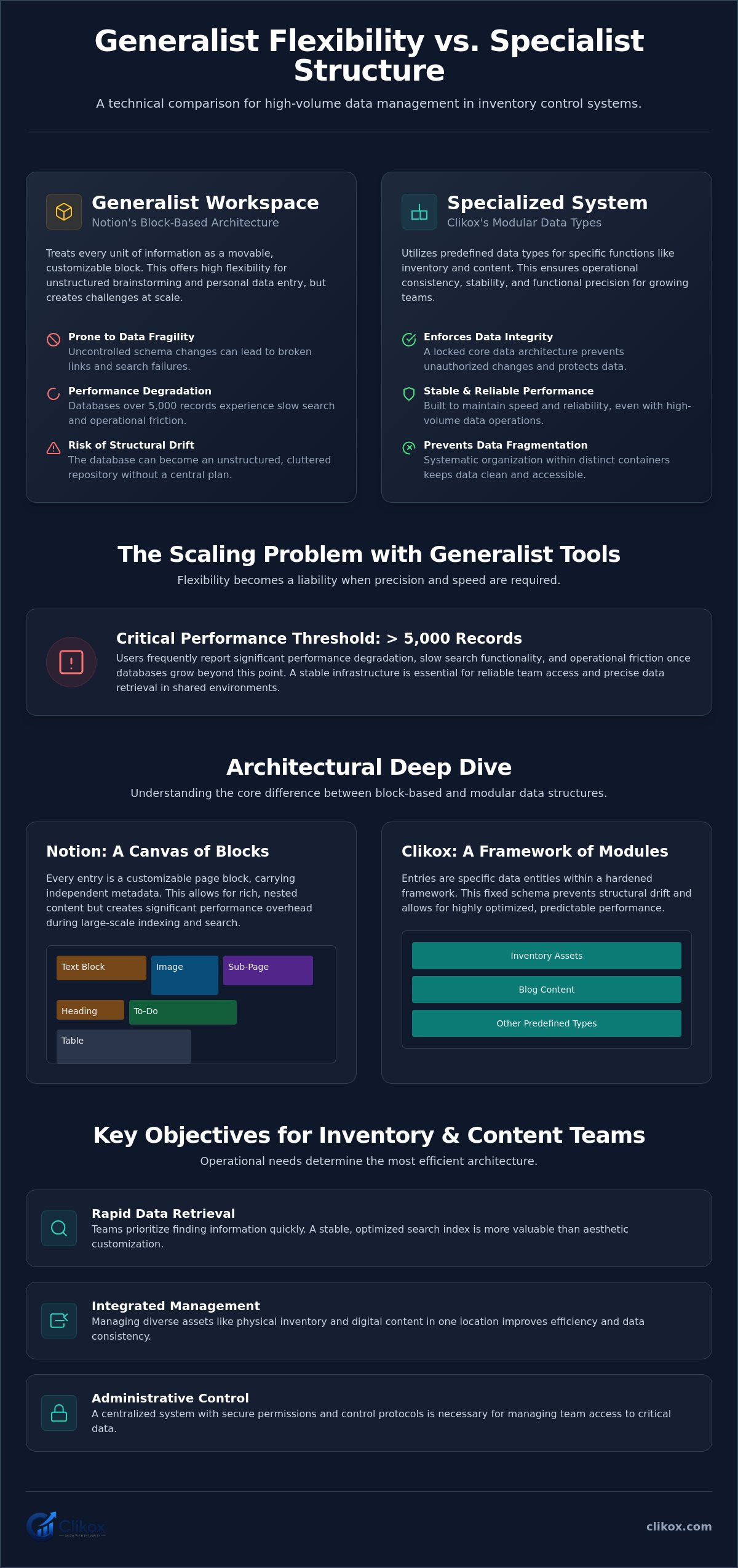
Notion utilizes a block-based architecture for general-purpose data entry. This system treats every unit of information as a movable block. Users arrange these blocks to create custom pages and databases. This architecture provides high flexibility for unstructured brainstorming. Clikox provides a centralized platform for five distinct data types. These data types are predefined to ensure operational consistency. The comparison between the Clikox vs Notion database reveals a fundamental difference in system design. One platform prioritizes the freedom to build. The other platform prioritizes the stability of the build.
Specialization reduces the cognitive load required to maintain database order. Users don't need to decide how to structure an inventory record. The system provides the necessary fields and relations automatically. This structured approach eliminates the need for constant architectural decisions. Generalist tools require manual enforcement of data standards. A team must establish strict rules to prevent database clutter. Users must verify that every entry follows the same format. This manual oversight is time-consuming. It creates a risk of system fragmentation as the database grows.
The Definition of Data Fragility
Flexible systems allow users to alter schemas without protocol. A team member can change a property type in a shared database. This change can occur without a global warning. Such actions create data fragility within the workspace. Structured systems maintain data integrity through standardized templates. The schema remains fixed to protect the underlying data. Fragility leads to search failure and broken relational links. If a property is renamed or deleted, the associated search index may fail. A reliable inventory management software requires a stable schema to ensure long-term data retrieval. Clikox prevents these structural breaks by locking the core data architecture.
Operational Objectives for Inventory Teams
Teams prioritize rapid data retrieval over aesthetic customization. The primary goal is to find information quickly. Inventory managers need to verify stock levels in seconds. They don't need to adjust the background color of a database page. Centralization requires a system that handles inventory and blogs simultaneously. Managing these different data types in one location improves efficiency. The Clikox vs Notion database choice depends on the need for this integration. Clikox automates the organization of these specific repositories. It places inventory items and blog posts into distinct, optimized containers. This automation ensures that data remains clean and accessible for all team members. Precise search functionality depends on this systematic arrangement of information.
Technical Architecture: Notion Blocks vs. Clikox Data Types
Notion databases treat every entry as a customizable page block. This block-based system allows users to embed sub-pages, images, and text within a single record. This architecture provides a high degree of flexibility for personal data entry. It also creates significant performance overhead during large-scale operations. Every block carries independent metadata. This metadata must be indexed by the system. Clikox utilizes a modular system designed for administrative precision. It doesn't treat entries as generic blocks. It treats entries as specific data entities within a hardened framework. This distinction is central to the Clikox vs Notion database comparison. Teams must choose between a canvas and a structured system.
Clikox manages five specific data types. These types include inventory assets and blog content. This specific categorization prevents structural drift. Structural drift occurs when a database evolves away from its intended purpose. Notion is prone to this drift. Users add properties without a central plan. Users delete properties without checking dependencies. The database becomes an unstructured repository. Clikox maintains a rigid data schema. This rigidity ensures operational stability. The system remains predictable regardless of user input. Data categorization in Clikox is fixed to prevent these structural failures. It provides an invisible, highly organized infrastructure for team data.
Inventory and Blog Integration
Clikox provides a unified space for tracking physical assets and digital content. Integrated blog management allows for software to manage blogs and inventory. This centralization eliminates the need for context switching between different apps. Notion requires separate database relations to link disparate data types. These relations are often fragile. They break when shared across different workspaces or guest accounts. Clikox maintains these connections within a single framework. It maps content directly to product repositories. This integration ensures that inventory levels and marketing assets remain synchronized.
Schema Stability and Maintenance
Clikox maintains a clinical focus on functional clarity. The infrastructure is ready for immediate deployment. It doesn't require custom builds or template configuration. Notion schemas often require constant manual adjustment by an admin. An administrator must monitor property changes. They must ensure that blocks remain correctly categorized. This manual oversight is inefficient for growing teams. Clikox infrastructure is ready for use without these custom requirements. It removes the need for a dedicated system architect. Teams requiring immediate operational stability can explore Clikox Inventory Software for their administrative needs. The system provides a perfectly ordered environment for all organizational data.
Operational Efficiency: Search Performance and Data Retrieval
Search indexing in generalist tools covers thousands of irrelevant blocks. Every text fragment and image is an indexable unit. This creates a high volume of search noise. Finding a specific SKU requires filtering through unrelated meeting notes. Clikox search focuses on specific inventory and campaign data parameters. The indexing protocol is limited to functional data fields. This limitation increases retrieval speed. Precise categorization leads to faster retrieval in high-volume environments. It removes the latency associated with general-purpose search engines. It's a critical factor in the Clikox vs Notion database decision. The performance gap widens as the dataset grows.
Growing wikis often experience the search graveyard effect. This occurs when outdated blocks remain in the global index. Users frequently retrieve obsolete records. Clikox avoids this effect by maintaining a modular data structure. The system categorizes information into active repositories. It prioritizes current inventory and campaign data. This systematic approach ensures that the search function remains a reliable tool. It doesn't become a source of operational friction. The index remains clean and focused on administrative utility.
Indexing Large Inventory Repositories
Clikox maintains performance speed regardless of the number of entries. The underlying database architecture is optimized for large-scale administrative tasks. It handles thousands of records without a decrease in responsiveness. Notion search performance often correlates negatively with database size. The system must scan every block to provide a result. This process becomes slower as more pages are added. Reliable data tracking requires instant access to campaign and analytics data. Operational teams can't wait for slow page loads. Clikox provides immediate results by targeting specific data types.
Mobile Accessibility and Data Accuracy
Notion mobile performance is often cited as a primary user pain point. The mobile client must render complex block layouts and various media types. This consumes significant device memory and processing power. It often leads to application crashes or slow navigation during field audits. Clikox provides a streamlined interface for rapid data entry on-site. The interface is utilitarian and focuses on functional input. It lacks unnecessary aesthetic elements that slow down performance. Systematic arrangement ensures data accuracy for remote teams. Users enter information into predefined fields that match the desktop schema. This prevents the input of fragmented or unlinked data blocks. Teams can utilize Clikox Inventory Software to ensure consistent data entry from any location. The system maintains its clinical precision across all hardware platforms. It provides a stable environment for mobile data management.
Administrative Control: Permissions and License Activation
Clikox utilizes a centralized admin dashboard for customer and content management. This dashboard provides a single point of oversight for all system activities. Administrative control is a primary differentiator in the Clikox vs Notion database comparison. Notion permissions are often decentralized across various pages and blocks. This decentralization increases the risk of accidental data deletion. Guest users in Notion can modify database properties without strict oversight. Clikox maintains a hardened permission structure. This structure ensures that only authorized personnel can alter the system schema. It prevents the structural drift discussed in previous sections.
Permission structures in Clikox are designed for administrative oversight. The system assigns specific roles to each user. These roles determine the level of access to inventory and blog repositories. Notion utilizes a more fluid permission model. This model allows for granular access but lacks a centralized control mechanism. It requires manual verification of every shared page. This manual process is prone to human error. Clikox automates permission enforcement through its modular architecture. It ensures that data remains secure and accessible to the correct individuals. Administrative precision is the priority.
License Management for Professional Units
Clikox allows for license activations for specific software instances. This protocol ensures that each software unit remains isolated and secure. It is a fundamental requirement for inventory management with user roles. Notion lacks a formal license activation system for segregated data instances. All data exists within a single workspace environment. This shared environment complicates the separation of distinct professional units. Clikox license management provides a clear boundary for organizational data. It allows for the deployment of multiple independent systems under a single administrative umbrella.
Team Collaboration Protocols
Clikox facilitates tracking and sharing work in one place without complexity. It uses a secure administrative interface for user registration. This interface manages access levels for team members and external stakeholders. Administrative precision prevents unauthorized schema changes. Users cannot delete core data categories by mistake. The system architecture remains stable during collaborative tasks. It provides an invisible, highly organized infrastructure for team data. Organizations can secure their data infrastructure by obtaining License Activations for their team. This ensures every user operates within a validated environment. Systematic coordination depends on this administrative stability.
Final Selection: Choosing a Centralized Data Infrastructure
The final selection between the Clikox vs Notion database depends on the specific operational environment. Notion is suitable for personal wikis and unstructured brainstorming. It provides an open canvas for individual notes. It allows for rapid layout changes. Clikox is the preferred solution for systematic inventory and blog management. It provides a hardened framework for team data. The decision depends on the requirement for flexibility versus structural stability. Professional units require high stability. Transitioning to Clikox reduces operational complexity for distributed units. It replaces manual oversight with automated data protocols.
A structured system ensures that data remains reliable over time. Generalist tools allow for excessive customization. This customization often leads to database fragmentation. Clikox maintains a clinical focus on administrative utility. It organizes information into distinct, searchable repositories. This organization prevents the accumulation of irrelevant data blocks. Teams can access their inventory and content without scanning unrelated pages. The Clikox vs Notion database comparison highlights the trade-off between creative freedom and functional precision. Systematic operations prioritize precision.
When to Choose Clikox Inventory Software
Organizations should choose Clikox when managing multiple data types in a professional environment. The system handles inventory assets and digital content within a unified space. Clikox is optimal for teams requiring license-based software access. This model ensures that each instance of the software remains secure. It's ideal for organizations that must import inventory from spreadsheet environments. The import protocol maintains data integrity during the transition. It maps existing spreadsheet columns to the structured Clikox schema. This prevents the loss of critical information during data migration. It ensures a seamless shift to a centralized infrastructure.
Evaluating Long-Term Data Scalability
Clikox provides a stoic reliability that generalist tools lack at scale. Database performance remains consistent as the number of records increases. Structured data architecture prevents the accumulation of technical debt. Technical debt occurs when a system becomes too complex to maintain. Clikox avoids this complexity by locking the core data schema. Users can't introduce structural errors. Administrative dashboards provide the necessary analytics for campaign tracking. These dashboards offer real-time insights into inventory levels and content performance. They provide the data points needed for informed decision-making. A stable infrastructure is the foundation of professional growth. Clikox delivers this foundation through its disciplined architecture.
Establishing Operational Stability with Structured Data
The technical analysis of the Clikox vs Notion database confirms that architectural specialization is required for high-volume inventory management. Generalist tools provide flexibility for individual tasks. Professional teams require structural stability to prevent data fragmentation. Specialized systems ensure precise search functionality. They maintain schema integrity during team collaboration. This approach eliminates the latency found in block-based systems. It's a reliable method for ensuring that data remains accessible and accurate as the repository scales. Precise categorization prevents the accumulation of technical debt.
Efficient data management requires a centralized infrastructure. Clikox provides centralized management of 5 data types. It features integrated blog and inventory tracking within a single environment. The professional admin dashboard utilizes license activation to secure organizational data. Teams don't have to manage fragmented systems. These features provide a stoic foundation for distributed units. Teams can now Access Clikox Inventory Software for Professional Teams to standardize their administrative workflows. This infrastructure supports long-term operational success. A perfectly ordered system is ready for immediate deployment.
Frequently Asked Questions
Is Clikox a better alternative to Notion for database management?
Clikox is a specialized alternative for teams requiring high structural stability. It provides a fixed schema designed for inventory and content assets. Notion functions as a generalist tool for unstructured data entry. The Clikox vs Notion database choice depends on the need for administrative precision. Clikox prevents structural drift through its modular architecture. It ensures data integrity for professional operations where schema changes must be restricted.
How does Clikox handle integrated blog management compared to Notion?
Clikox integrates blog management directly into the core inventory framework. Users manage physical assets and digital content within one unified interface. Notion requires relational links between separate databases to connect these data types. These links often break during workspace sharing or guest access. Clikox maintains these connections within a single administrative dashboard. This integration ensures that content remains synchronized with current inventory levels without manual updates.
What are the primary data types managed by Clikox Inventory Software?
Clikox Inventory Software manages five distinct data types. These include inventory assets, blog content, campaign data, and analytics repositories. Every data type follows a predefined schema to ensure operational consistency. This categorization ensures that information remains organized as the dataset grows. It facilitates the rapid retrieval of specific administrative records. The system treats each data type as a discrete unit within a hardened framework.
Can I use Clikox for team collaboration and user registration?
Clikox supports team collaboration through a secure administrative interface. Administrators manage user registration and permission levels from a central dashboard. This interface controls access to specific data repositories. It prevents unauthorized changes to the system architecture by guest users. Team members track and share work in one place without operational complexity. The system maintains a perfectly ordered environment for all collaborative administrative tasks.
Does Clikox require a license activation for each user?
Clikox requires license activations for specific software instances. This protocol ensures secure access for professional units and teams. It allows for the deployment of independent systems under one administrative umbrella. License management provides a clear boundary for organizational data. It ensures that every user operates within a validated environment. This activation process is essential for maintaining the security of segregated data instances in professional environments.
Is search performance better in Clikox or Notion for large inventories?
Search performance is faster in Clikox for large datasets. The indexing protocol focuses only on specific administrative fields within the Clikox vs Notion database comparison. Notion search scans every block in the workspace. This process often slows down as the database size increases beyond 5,000 records. Clikox maintains consistent retrieval speeds regardless of repository size. It avoids the search noise associated with generalist tools that index irrelevant blocks.
Can I manage marketing campaigns and analytics within Clikox?
Clikox facilitates the management of marketing campaigns and analytics data. The system provides dedicated repositories for tracking campaign performance metrics. It integrates these metrics with inventory and blog content for a unified view of activity. This integration allows for precise data tracking without external tools. It provides the necessary analytics for campaign oversight within the same administrative dashboard. Users can verify content performance and stock levels simultaneously.
Is Clikox suitable for solo users or only for large teams?
Clikox is suitable for both solo users and large teams. The software provides a stable infrastructure for individual data management. It also scales to accommodate team collaboration through its administrative dashboard. Solo users benefit from the perfectly ordered data architecture. Teams benefit from centralized permission control and license management. The system architecture remains consistent regardless of the number of users accessing the database.